استعمال شدہ گاڑی کو خود کیسے جانچیں
جب گاڑی دیکھیں تو یہ ترتیب سے کریں۔ یہ تب بھی کام آتا ہے جب یہ آپ کی پہلی گاڑی ہو۔ 🔴 نہ چھوڑیں والے مراحل وہ ہیں جہاں مہنگے سرپرائز چھپے ہوتے ہیں۔ یہ عام مشورے ہیں۔ کسی ایک گاڑی کے لیے اس کا اشتہار کھولیں اور اس ماڈل کے چیک دیکھیں۔
علامات پہچانیں
استعمال شدہ گاڑی کے زیادہ تر مسائل ان میں سے کسی ایک جیسے دکھتے ہیں۔ کسی ایک گاڑی کے لیے اس کا اشتہار کھولیں اور چیک شروع کریں۔ وہاں اس ماڈل کے چیک اور لائیو گریڈ ملتا ہے۔
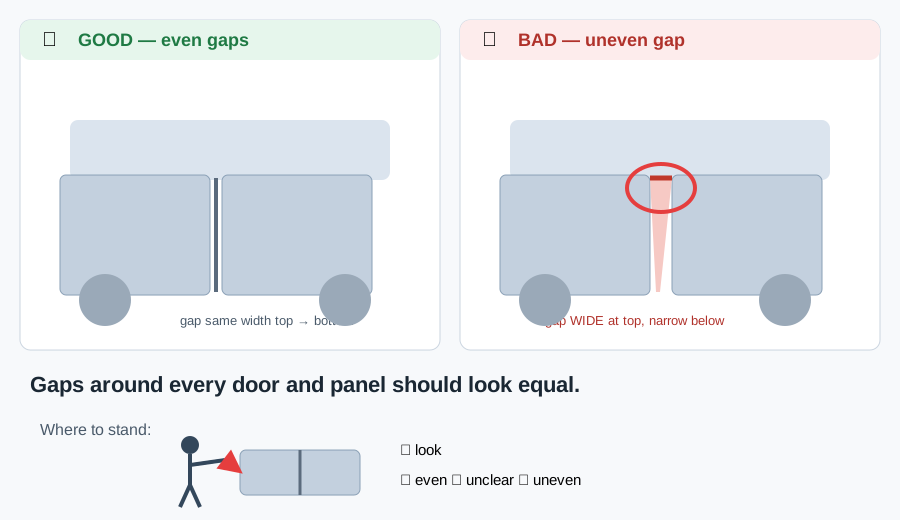
Walk around the car in good daylight. Sight down each side at a shallow angle and check that panel gaps (doors, bonnet, boot, fenders) are even and symmetric left-to-right. Why: Uneven or wide/tight gaps are a classic sign of accident repair, a replaced panel, or a bent structure that was pulled back into shape. Red flag: Panel gaps clearly wider or misaligned on one side vs the other, doors/bonnet not sitting flush, or bolts around fenders/bonnet showing paint scuffs from being removed.
Compare the shade, texture and reflection of each panel to its neighbours, including in the door jambs and under the fuel flap. Look for overspray on rubber trim, plastics and glass. Why: A single repainted panel that does not match indicates prior damage; overspray on seals suggests a fast, non-factory respray hiding something. Red flag: Colour mismatch between adjacent panels, orange-peel/rough texture on one panel only, or paint overspray on window rubbers, badges or plastic trim.
Feel panels for waviness and ripples under strong light. If you have a cheap paint-depth gauge or fridge magnet, test several panels; a magnet grips weakly over thick filler on steel panels. Why: Body filler and thick repaint reveal hidden dents or crash repair that photos and a quick glance miss. Red flag: Visible ripples/waves under light, magnet that slides or holds weakly on a steel panel, or paint-gauge readings far higher on one panel than the rest.
Check lower doors, sills, wheel arches, boot floor and spare-wheel well for rust, water lines, silt or a musty smell. Look under carpets and mats for dampness or mud. Why: The UAE has flood-damaged and salvage cars in circulation; water damage causes long-term electrical and corrosion faults that surface later. Red flag: Rust bubbling, a tide/water line inside the boot or cabin, silt in seat rails or seatbelt bases, or a persistent damp/mouldy smell.
Check tread depth across each tyre and compare inner, middle and outer edges. Note the DOT date code (week/year) on each sidewall. Why: Uneven wear signals alignment, suspension or chassis problems; in UAE heat, old rubber (even with tread) is prone to dangerous blowouts. Red flag: Tread worn to the wear bars, one edge far more worn than the other (alignment/suspension), or tyres more than ~5-6 years old by DOT code regardless of tread.
Confirm all four tyres are a sensible matched set and inspect sidewalls for heat cracking, bulges or plug repairs. Check the spare, jack and tools are present and the spare holds air. Why: Sidewall cracks and bulges are common in UAE heat and can fail catastrophically; a missing/flat spare leaves the buyer stranded. Red flag: Sidewall cracking or a bulge, mismatched brands/sizes across an axle, visible plug/patch repairs, or a missing/perished spare.
Inspect the windscreen and all glass for chips and cracks. Check that all glass carries a consistent manufacturer/date etching. Test every exterior light: headlights (low/high), indicators, brake lights, reverse, fog and hazard. Why: A cracked windscreen is a Tasjeel inspection failure; mismatched glass dates hint at accident replacement; dead lights are both a safety and re-registration issue. Red flag: Cracked windscreen or a chip in the driver's sightline, one glass panel with a very different date/brand stamp, or any exterior light not working or heavily fogged/cracked.
Compare wear on the steering wheel, gear shifter, seat bolsters, pedals and floor mats against the odometer reading. Look for a shiny/worn steering wheel or pedal rubbers on a supposedly low-mileage car. Why: Interior wear that outpaces the odometer is one of the clearest tells of odometer rollback, a known UAE scam. Red flag: Heavily worn wheel, shifter, seat or pedals inconsistent with a low displayed mileage.
Test windows, central locking, mirrors, seat adjustment (incl. electric/heated), infotainment, reversing camera/sensors, horn, wipers/washers and all warning-chime functions. Why: Electrical faults are expensive and can indicate prior water damage or poor repairs; UAE heat is hard on electronics. Red flag: Any window, lock, mirror, camera or infotainment function that fails or works intermittently.
Start the car, set AC to max cold/high fan and hold a thermometer or your hand at the centre vent for several minutes. Note how quickly it gets cold and whether it stays cold at idle. Why: In UAE heat a weak AC is a safety and liveability failure and often the single most expensive common repair (compressor/evaporator). Red flag: Air not getting genuinely cold within a few minutes, cold air fading at idle or in traffic, a chemical/mouldy smell, or the AC clutch cycling loudly.
Confirm the airbag/SRS warning light illuminates at key-on and then goes out. Inspect steering wheel and dashboard airbag covers for tampering, and check all seatbelts extend, retract and latch. Why: A missing or permanently-off SRS light can mean deployed airbags were never replaced after a crash - a life-safety issue and a sign of hidden accident history. Red flag: SRS light never illuminates or stays on, mismatched/ill-fitting airbag covers, or a seatbelt that will not retract/latch.
With the engine cold and off, check oil (level and colour), coolant (level and colour in the reservoir), brake fluid and power-steering/transmission fluid. Look for wet spots, crust or drips on and around the engine. Why: Low or contaminated fluids and active leaks indicate neglect or impending expensive failures (head gasket, seals, transmission). Red flag: Milky/foamy oil or coolant (possible head gasket), oil like tar or gritty, low fluid levels, or fresh leaks pooling on the engine or components.
Inspect the drive/serpentine belt for cracks or glazing, squeeze hoses for softness/bulges, and check the battery terminals and date. Look for melted, taped or amateur wiring. Why: Perished belts and hoses fail fast in UAE heat; makeshift wiring signals prior electrical problems or a poorly repaired car. Red flag: Cracked/glazed/frayed belt, soft or bulging hoses, heavy corrosion on battery terminals, or spliced/taped/hand-modified wiring.
Look at the radiator support, inner fenders and strut towers for wrinkling, welds, fresh paint, or bolts that have been disturbed. Compare left vs right symmetry. Why: These are structural areas; damage or repair here (not just cosmetic panels) reveals a serious past collision. Red flag: Wrinkled or re-welded metal, mismatched fresh paint in the engine bay, or radiator-support/bumper bolts showing tool marks and disturbed paint.
Look under the car (safely) for leaks, dents, scrapes, fresh undercoating hiding repairs, exhaust corrosion/leaks, and torn CV/steering boots or leaking shocks. Why: The underside reveals impact damage, leaks and worn suspension that a clean top-side hides. Red flag: Active drips, bent/crumpled floor or subframe, torn CV boots, oily/leaking shock absorbers, or suspiciously fresh undercoat sprayed over one area.
If possible with the seller's consent, check for play by rocking each wheel (top-bottom and side-side) and look at brake disc/pad wear through the wheel spokes. Why: Wheel-bearing, ball-joint and tie-rod wear are safety items; heavily lipped/scored discs mean imminent brake spend. Red flag: Noticeable play when rocking a wheel, clunks, deeply scored/lipped discs, or very thin pads.
Turn the key to ignition (engine not yet running) and confirm the full cluster lights up, then start and confirm warning lights extinguish: check engine, ABS, airbag, oil, battery, traffic-control. Why: Sellers sometimes remove bulbs to hide faults; a bulb that never lights is as suspicious as one that stays on. Red flag: Any warning light staying on after start, or a light (esp. check-engine/airbag) that never illuminates at key-on, suggesting a removed bulb.
If you have an OBD-II scanner or phone dongle, plug in and read stored, pending and permanent trouble codes, plus readiness monitors. Note any codes that were recently cleared (all monitors 'not ready'). Why: An OBD scan surfaces faults masked visually; a car with all monitors freshly reset may have had codes cleared right before viewing. Red flag: Stored/pending emission or drivetrain codes, or all readiness monitors 'not ready' indicating a very recent battery/code reset before your visit.
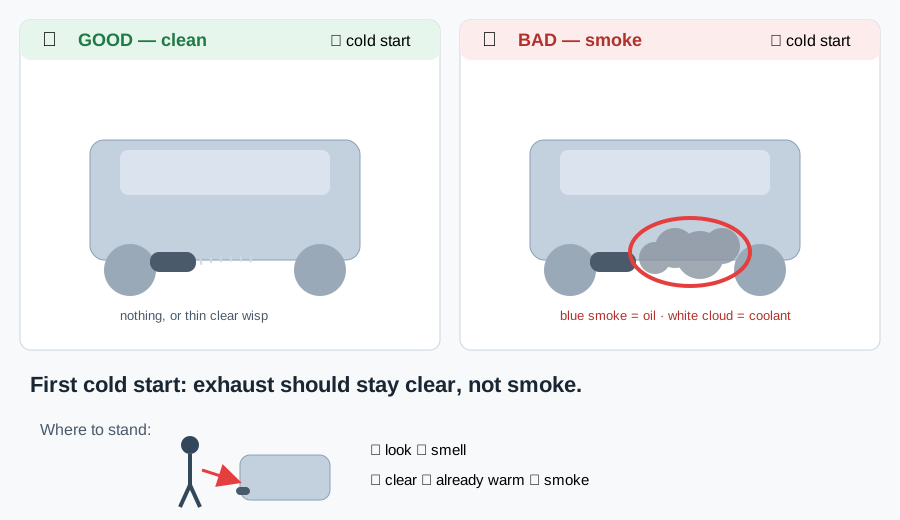
Insist on a genuinely cold start (engine not pre-warmed by the seller). Watch for excessive cranking, smoke from the exhaust, rough idle and any knocking that fades as it warms. Why: A pre-warmed engine hides hard-starting, smoking and cold-knock problems; cold start is the most revealing moment. Red flag: Seller has already warmed the car, long cranking to start, blue (oil) or white (coolant) smoke, or knocking/rattling on cold start.
On a straight, level road briefly ease off the wheel to see if the car tracks straight. Note vibration through the wheel at speed and any wandering. Why: A pull or vibration points to alignment, worn suspension, warped discs or - combined with body signs - chassis damage. Red flag: Car pulls to one side on a level road, steering-wheel vibration at speed, or a wheel that sits off-centre when driving straight.
In a safe area, brake firmly from moderate speed. Feel for pulling, a spongy or long pedal, pulsing (warped discs), or grinding/squealing. Test that ABS engages if you can do so safely. Why: Brakes are the primary safety system; pulling or pulsing indicates worn/warped components or uneven repair. Red flag: Pulling to one side under braking, pulsing pedal, spongy/long pedal travel, or grinding/metallic noise.
Drive through the full range: accelerate gently and firmly, watch for smooth, timely automatic shifts (or clean clutch/gear engagement on a manual). Listen for whine, clunk or slip. Test reverse. Why: Transmission repairs/replacements are among the most expensive failures; slipping or harsh shifts flag major cost ahead. Red flag: Slipping (revs rise without speed), harsh/delayed shifts, clunk into gear, shudder, or warning light after a hard pull.
During the drive keep the AC on max and monitor cabin cooling while climbing/accelerating, and watch the coolant temperature gauge in traffic and at speed. Why: In UAE conditions a car may cool at idle but fail under load; a climbing temp gauge signals cooling-system trouble that is dangerous in the heat. Red flag: AC warming under acceleration or in traffic, temperature gauge climbing above normal, or radiator fans that never engage.
Read the Mulkiya (vehicle registration card). Confirm the owner name matches the seller's Emirates ID, and note make/model/year/colour and registration expiry. If the seller is not the owner, require a notarised power of attorney. Why: In the UAE a sale is only legal once the Mulkiya is reissued in the buyer's name at the RTA; selling on someone else's card without a notarised POA is a common fraud route. Red flag: Seller name does not match the Mulkiya, no notarised POA when selling for someone else, or details on the card not matching the actual car.
Match the VIN/chassis number across the dashboard plate, the driver's door-jamb sticker and the Mulkiya - all three must be identical. Review stamped service history / workshop invoices and cross-check the mileage trend against the odometer. Why: VIN mismatches indicate a stolen, cloned or cut-and-shut car; a mileage trend in the service records lower than 'now' proves odometer rollback. Red flag: VIN differs between dashboard, door and Mulkiya; missing/altered VIN plate; or service-history mileages inconsistent with the current odometer (e.g. an old invoice showing higher km than the dash today).
یہ آپ کو واضح مسائل خود ڈھونڈنے میں مدد دیتا ہے۔ یہ طے کرنے میں بھی مدد دیتا ہے کہ کس چیز کا پیسے دے کر معائنہ ہونا چاہیے۔ یہ خریدنے سے پہلے کسی ماہر کے مکمل معائنے کی جگہ نہیں لیتا۔ اگر یقین نہ ہو تو ادائیگی سے پہلے گاڑی کا معائنہ کروائیں۔